
-20%
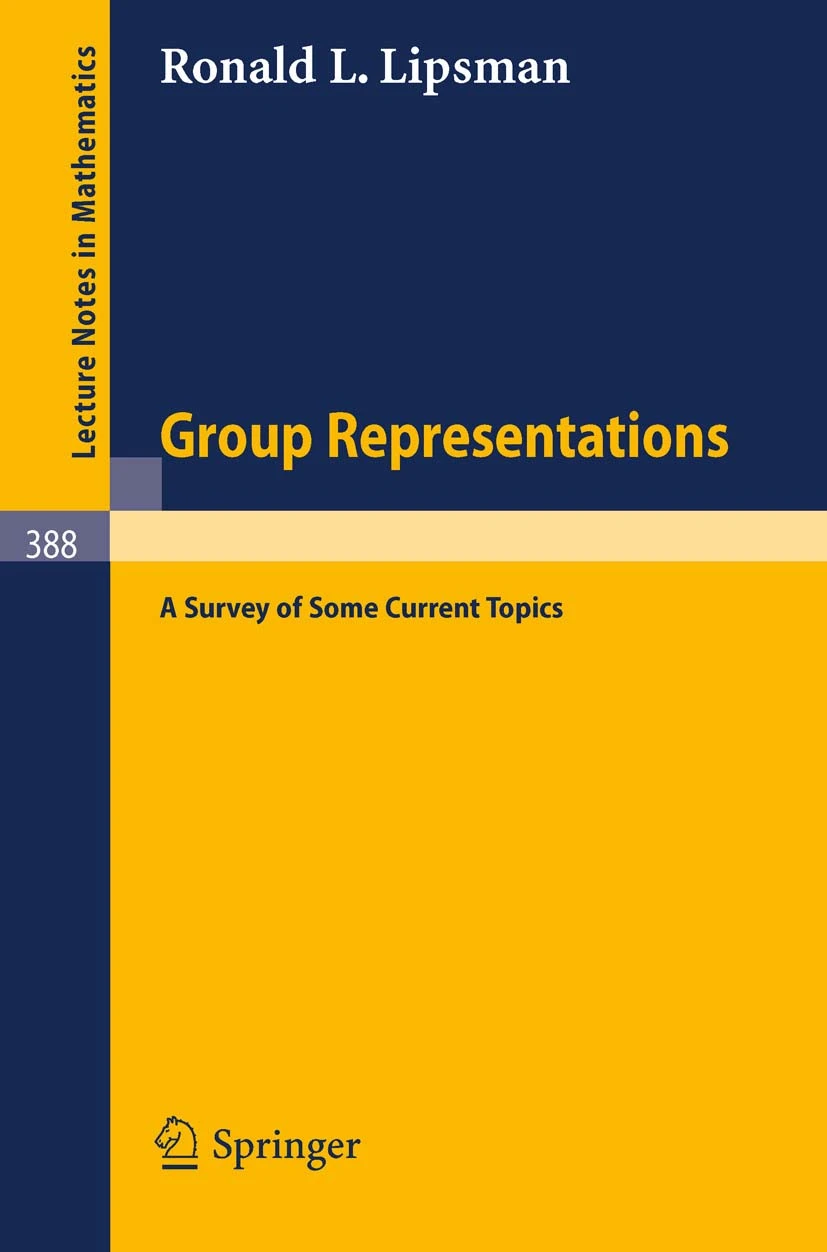
Group Representations: A Survey of Some Current Topics
Original price was: ₹2,901.00.₹2,321.00Current price is: ₹2,321.00.
Additional information
| Book Format | Hardcover, Softcover |
|---|
Book information
Edition
1st Edition
ISBN [Softcover]
9783540067900
Publisher
Springer
Year
1974
Pages
XII, 172 p.
Series Title
Lecture Notes in Mathematics
Language
English
Related Products
-20%

(Mostly) Commutative Algebra
Original price was: ₹5,511.00.₹4,410.00Current price is: ₹4,410.00.
Offers a unified presentation of stability results for dynamical systems using Lyapunov-like characterizations Provides derivation of strong/weak complete instability results for systems in terms of Lyapunov-like and comparison functions Discusses combined stability and avoidance problem for control systems from the perspective of Lyapunov functions
-20%
(Mostly) Commutative Algebra
Original price was: ₹5,511.00.₹4,410.00Current price is: ₹4,410.00.
Offers a unified presentation of stability results for dynamical systems using Lyapunov-like characterizations Provides derivation of strong/weak complete instability results for systems in terms of Lyapunov-like and comparison functions Discusses combined stability and avoidance problem for control systems from the perspective of Lyapunov functions
-20%

A Circle-Line Study of Mathematical Analysis
Original price was: ₹6,033.00.₹4,827.00Current price is: ₹4,827.00.
This book addresses the issue of uniqueness of a solution to a problem – a very important topic in science and technology, particularly in the field of partial differential equations, where uniqueness guarantees that certain partial differential equations are sufficient to model a given phenomenon.
-20%
A Circle-Line Study of Mathematical Analysis
Original price was: ₹6,033.00.₹4,827.00Current price is: ₹4,827.00.
This book addresses the issue of uniqueness of a solution to a problem – a very important topic in science and technology, particularly in the field of partial differential equations, where uniqueness guarantees that certain partial differential equations are sufficient to model a given phenomenon.
-20%

A Basic Course in Probability Theory
Original price was: ₹7,596.00.₹6,078.00Current price is: ₹6,078.00.
-20%
A Basic Course in Probability Theory
Original price was: ₹7,596.00.₹6,078.00Current price is: ₹6,078.00.
-20%
A Complex Analysis Problem Book
Original price was: ₹9,681.00.₹7,746.00Current price is: ₹7,746.00.
The aim of this work is the definition of the polyhedral compactification of the Bruhat-Tits building of a reductive group over a local field. In addition, an explicit description of the boundary is given.
-20%
A Complex Analysis Problem Book
Original price was: ₹9,681.00.₹7,746.00Current price is: ₹7,746.00.
The aim of this work is the definition of the polyhedral compactification of the Bruhat-Tits building of a reductive group over a local field. In addition, an explicit description of the boundary is given.
Reviews
There are no reviews yet.