
-20%

Probability-1
Price range: ₹4,994.00 through ₹6,912.00
Successfully synthesizes the most important classical ideas and results with many of the major achievements of modern probability theory Author provides clear and comprehensive introduction to probability theory
-20%
Probability-1
Price range: ₹4,994.00 through ₹6,912.00
Successfully synthesizes the most important classical ideas and results with many of the major achievements of modern probability theory Author provides clear and comprehensive introduction to probability theory
-20%
Probability-2
Price range: ₹4,410.00 through ₹6,495.00
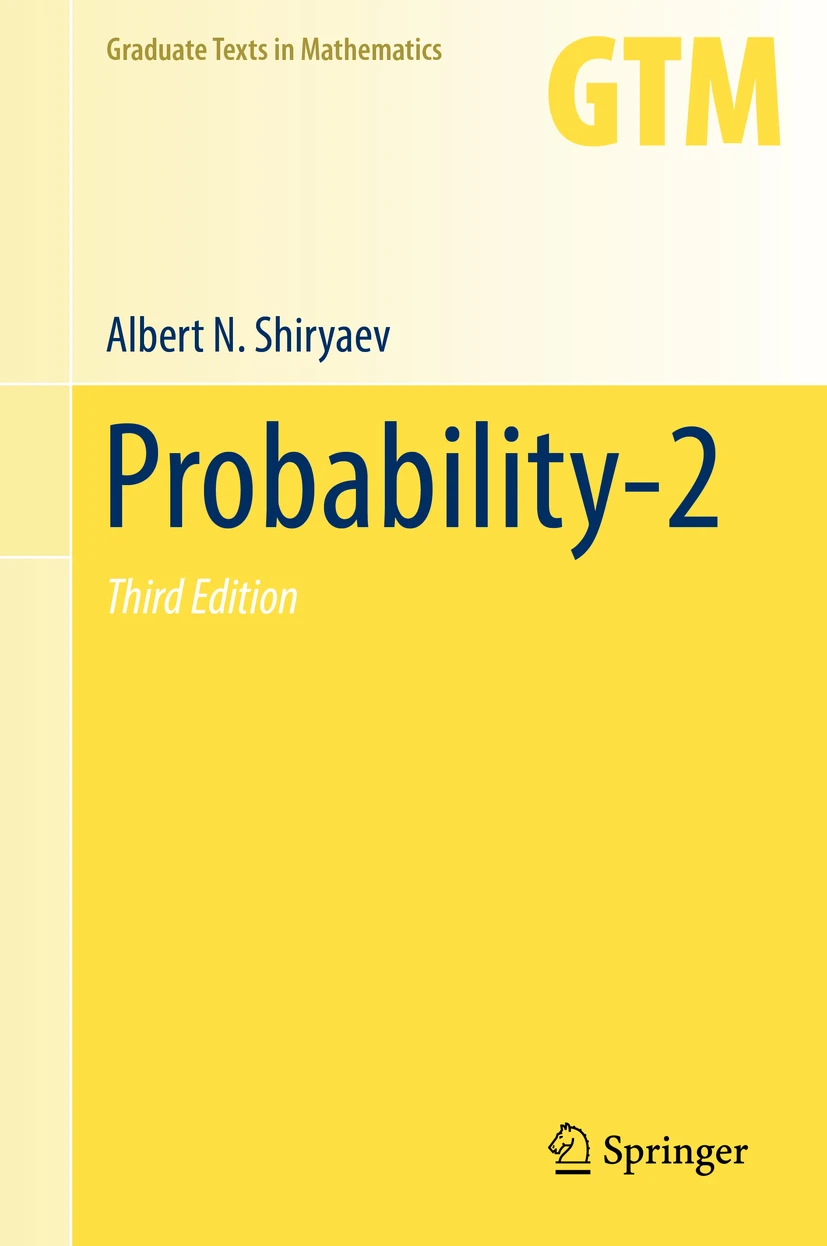
Along with Probability-1, forms the third English edition of the author’s classic Probability Offers new problems, exercises, proofs, and applications in financial topics and mathematical statistics Features a Historical Review charting the development of the mathematical theory of probability Synthesizes classical ideas and results with many of the major achievements of modern probability theory Suitable for a course on random processes or for independent study
-20%
Probability-2
Price range: ₹4,410.00 through ₹6,495.00
Along with Probability-1, forms the third English edition of the author’s classic Probability Offers new problems, exercises, proofs, and applications in financial topics and mathematical statistics Features a Historical Review charting the development of the mathematical theory of probability Synthesizes classical ideas and results with many of the major achievements of modern probability theory Suitable for a course on random processes or for independent study
-20%
Stochastic Disorder Problems
Original price was: ₹12,809.00.₹10,248.00Current price is: ₹10,248.00.
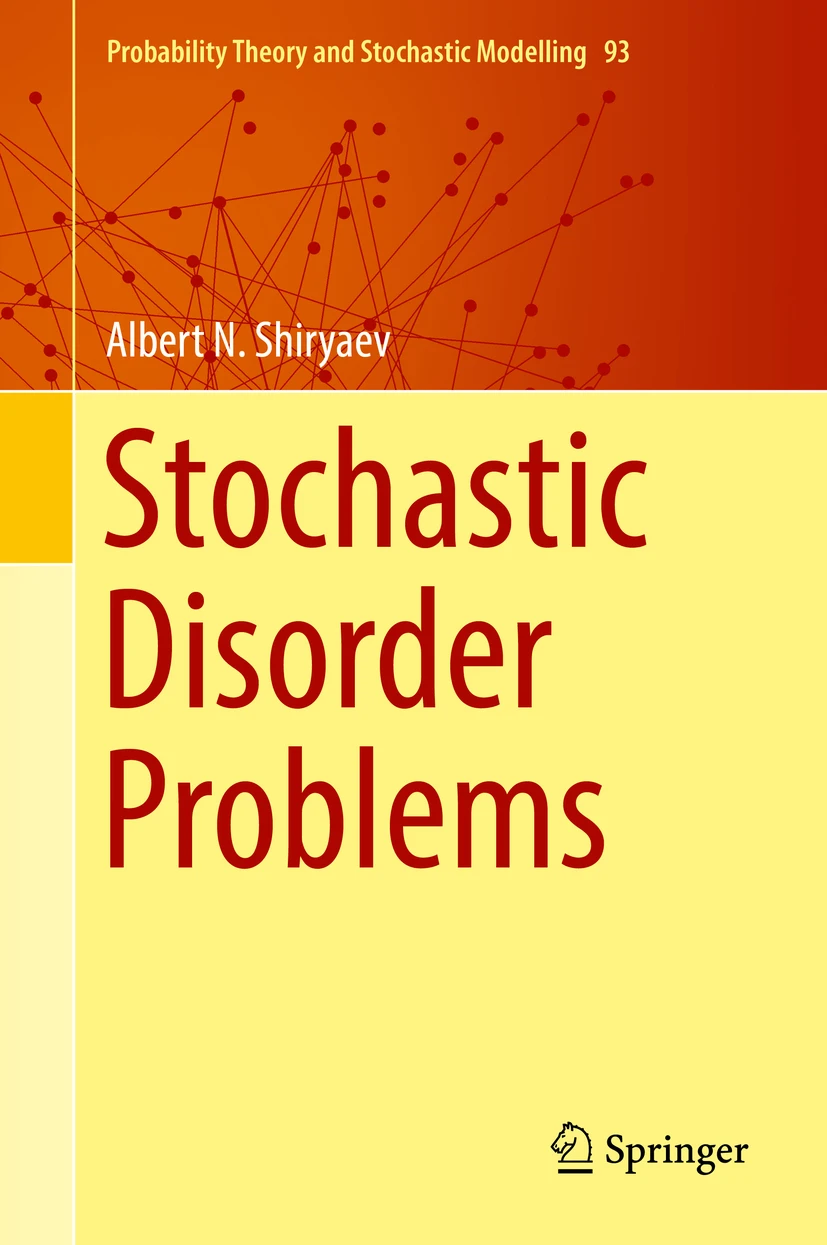
This monograph focuses on those stochastic quickest detection tasks in disorder problems that arise in the dynamical analysis of statistical data. These include quickest detection of randomly appearing targets, of spontaneously arising effects, and of arbitrage (in financial mathematics). There is also currently great interest in quickest detection methods for randomly occurring intrusions in information systems and in the design of defense methods against cyber-attacks. The author shows that the majority of quickest detection problems can be reformulated as optimal stopping problems where the stopping time is the moment the occurrence of disorder is signaled. Thus, considerable attention is devoted to the general theory of optimal stopping rules, and to its concrete problem-solving methods.The exposition covers both the discrete time case, which is in principle relatively simple and allows step-by-step considerations, and the continuous-time case, which often requires more technical machinery such as martingales, supermartingales, and stochastic integrals. There is a focus on the well-developed apparatus of Brownian motion, which enables the exact solution of many problems. The last chapter presents applications to financial markets.Researchers and graduate students interested in probability, decision theory and statistical sequential analysis will find this book useful.
-20%
Stochastic Disorder Problems
Original price was: ₹12,809.00.₹10,248.00Current price is: ₹10,248.00.
This monograph focuses on those stochastic quickest detection tasks in disorder problems that arise in the dynamical analysis of statistical data. These include quickest detection of randomly appearing targets, of spontaneously arising effects, and of arbitrage (in financial mathematics). There is also currently great interest in quickest detection methods for randomly occurring intrusions in information systems and in the design of defense methods against cyber-attacks. The author shows that the majority of quickest detection problems can be reformulated as optimal stopping problems where the stopping time is the moment the occurrence of disorder is signaled. Thus, considerable attention is devoted to the general theory of optimal stopping rules, and to its concrete problem-solving methods.The exposition covers both the discrete time case, which is in principle relatively simple and allows step-by-step considerations, and the continuous-time case, which often requires more technical machinery such as martingales, supermartingales, and stochastic integrals. There is a focus on the well-developed apparatus of Brownian motion, which enables the exact solution of many problems. The last chapter presents applications to financial markets.Researchers and graduate students interested in probability, decision theory and statistical sequential analysis will find this book useful.