
-20%
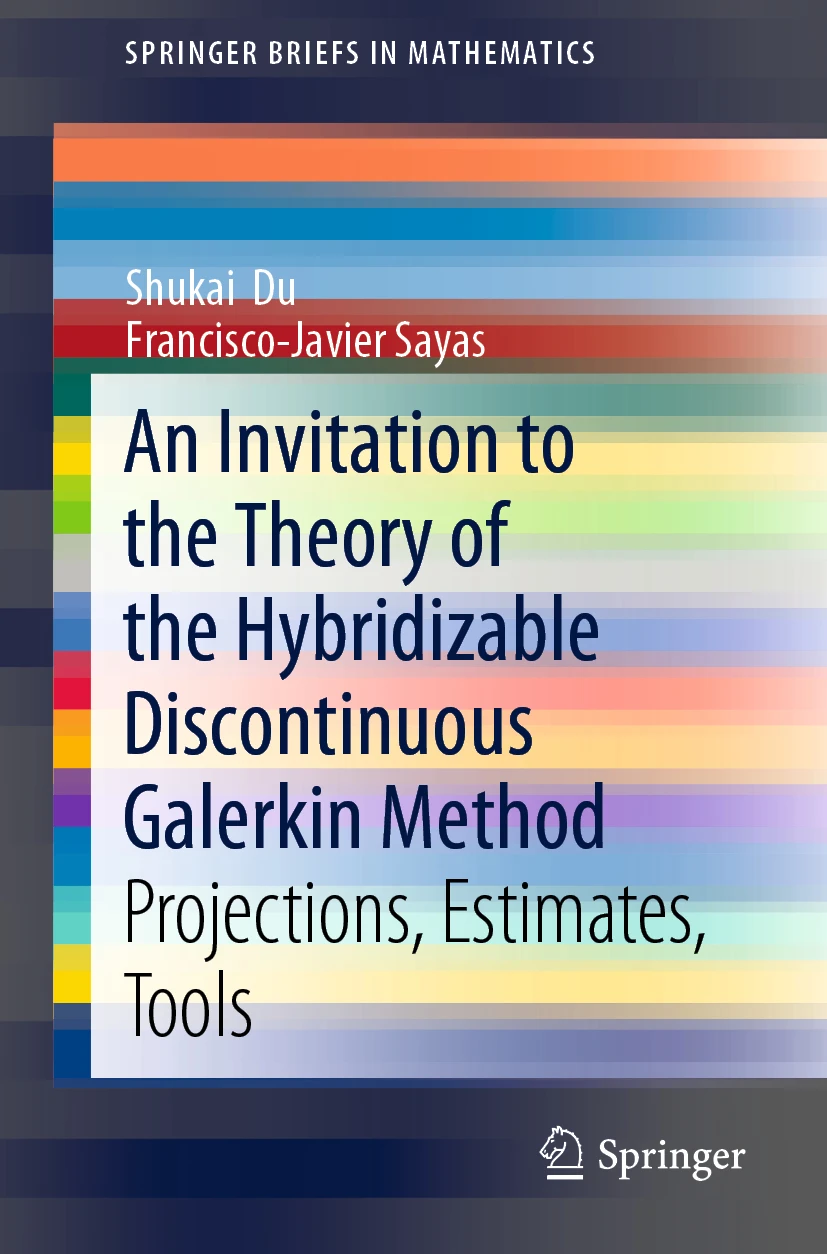
An Invitation to the Theory of the Hybridizable Discontinuous Galerkin Method: Projections, Estimates, Tools
Original price was: ₹6,033.00.₹4,827.00Current price is: ₹4,827.00.
First introduction to a systematic analysis of the Hybridizable Discontinuous Galerkin Method Presentation of new simplified techniques to prove estimates using the well-established projection-based analysis of HDG methods Covers applications to diffusion process (steady-state and evolutionary) and wave propagation (time-harmonic and transient)
-20%
An Invitation to the Theory of the Hybridizable Discontinuous Galerkin Method: Projections, Estimates, Tools
Original price was: ₹6,033.00.₹4,827.00Current price is: ₹4,827.00.
First introduction to a systematic analysis of the Hybridizable Discontinuous Galerkin Method Presentation of new simplified techniques to prove estimates using the well-established projection-based analysis of HDG methods Covers applications to diffusion process (steady-state and evolutionary) and wave propagation (time-harmonic and transient)
-20%
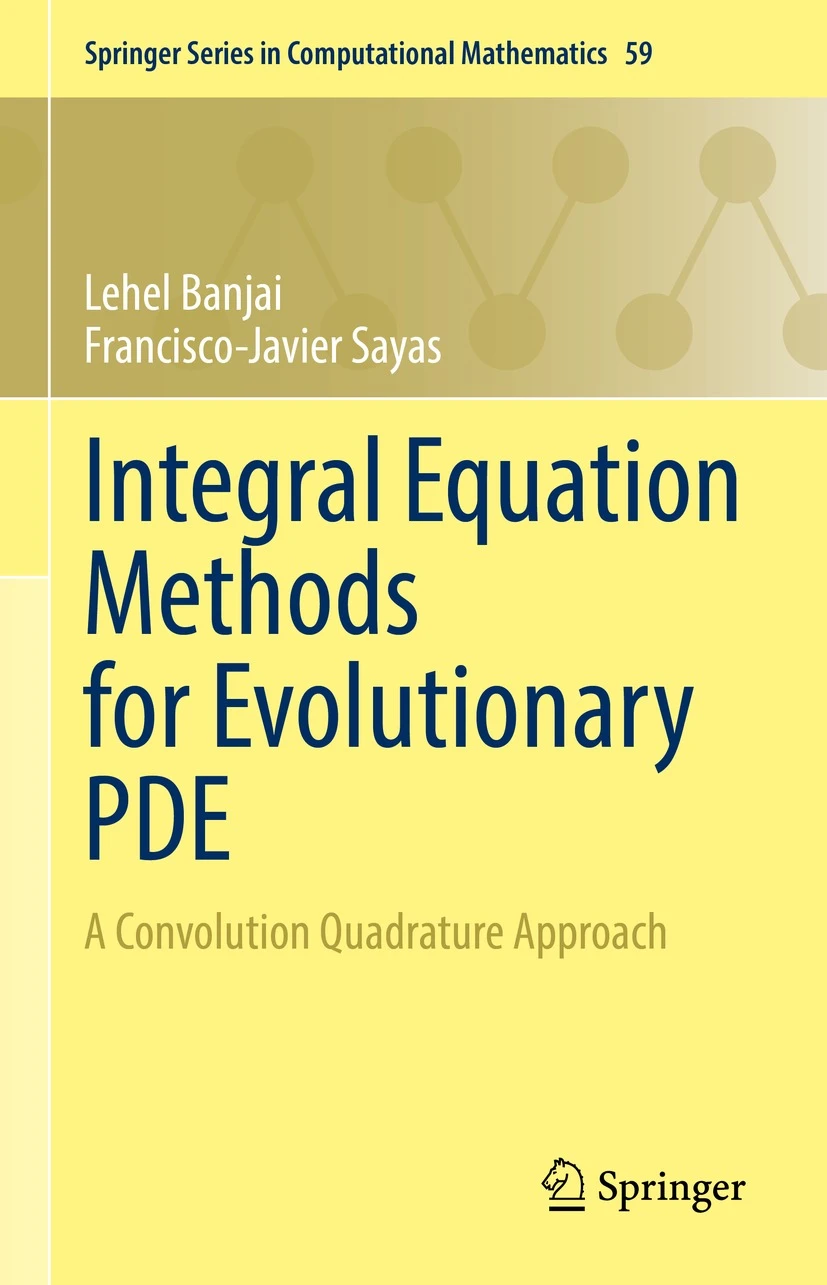
Integral Equation Methods for Evolutionary PDE: A Convolution Quadrature Approach
Original price was: ₹13,852.00.₹11,082.00Current price is: ₹11,082.00.
This book provides a comprehensive analysis of time domain boundary integral equations and their discretisation by convolution quadrature and the boundary element method.
Properties of convolution quadrature, based on both linear multistep and Runge–Kutta methods, are explained in detail, always with wave propagation problems in mind.
-20%
Integral Equation Methods for Evolutionary PDE: A Convolution Quadrature Approach
Original price was: ₹13,852.00.₹11,082.00Current price is: ₹11,082.00.
This book provides a comprehensive analysis of time domain boundary integral equations and their discretisation by convolution quadrature and the boundary element method.
Properties of convolution quadrature, based on both linear multistep and Runge–Kutta methods, are explained in detail, always with wave propagation problems in mind.