
-20%
Game Theory: Decisions, Interaction and Evolution
Original price was: ₹3,948.00.₹3,159.00Current price is: ₹3,159.00.
Provides three books in one: it covers the basic ideas of decision theory, classical game theory| and evolutionary game theory in one volume No background knowledge of economics or biology is required: examples have been carefully selected to be accessible to readers unfamiliar with these subjects Detailed solutions to the numerous exercises are provided at the back of the book, making it ideal for self-study
-20%
Game Theory: Decisions, Interaction and Evolution
Original price was: ₹3,948.00.₹3,159.00Current price is: ₹3,159.00.
Provides three books in one: it covers the basic ideas of decision theory, classical game theory| and evolutionary game theory in one volume No background knowledge of economics or biology is required: examples have been carefully selected to be accessible to readers unfamiliar with these subjects Detailed solutions to the numerous exercises are provided at the back of the book, making it ideal for self-study
-20%
Gems of Combinatorial Optimization and Graph Algorithms
Price range: ₹5,661.00 through ₹7,746.00
Gems of Combinatorial Optimization and Graph Algorithms is a handpicked collection of up-to-date articles, carefully prepared by a select group of international experts, who have contributed some of their most mathematically or algorithmically elegant ideas. Topics include longest tours and Steiner trees in geometric spaces, cartograms, resource buying games, congestion games, selfish routing, revenue equivalence and shortest paths, scheduling, linear structures in graphs, contraction hierarchies, budgeted matching problems, and motifs in networks.
-20%
Gems of Combinatorial Optimization and Graph Algorithms
Price range: ₹5,661.00 through ₹7,746.00
Gems of Combinatorial Optimization and Graph Algorithms is a handpicked collection of up-to-date articles, carefully prepared by a select group of international experts, who have contributed some of their most mathematically or algorithmically elegant ideas. Topics include longest tours and Steiner trees in geometric spaces, cartograms, resource buying games, congestion games, selfish routing, revenue equivalence and shortest paths, scheduling, linear structures in graphs, contraction hierarchies, budgeted matching problems, and motifs in networks.
-20%
Generalized Nash Equilibrium Problems, Bilevel Programming and MPEC
Price range: ₹5,244.00 through ₹7,329.00
The book discusses three classes of problems: the generalized Nash equilibrium problems, the bilevel problems and the mathematical programming with equilibrium constraints (MPEC). These problems interact through their mathematical analysis as well as their applications.
-20%
Generalized Nash Equilibrium Problems, Bilevel Programming and MPEC
Price range: ₹5,244.00 through ₹7,329.00
The book discusses three classes of problems: the generalized Nash equilibrium problems, the bilevel problems and the mathematical programming with equilibrium constraints (MPEC). These problems interact through their mathematical analysis as well as their applications.
-20%
Hamilton-Jacobi Equations: Approximations, Numerical Analysis and Applications: Cetraro, Italy 2011, Editors: Paola Loreti, Nicoletta Anna Tchou
Original price was: ₹4,990.00.₹3,993.00Current price is: ₹3,993.00.
It contains a quick and up to date introduction to viscosity solutions of Hamilton-Jacobi equations for graduate students or young researchers. Two approaches to large time behavior of periodic solutions of Hamilton-Jacobi Equations are given: PDE and weak KAM theory. Contributions on hot topics like for example numerical for mean field games should be of interest for many researchers Includes supplementary material: sn.pub/extras
-20%
Hamilton-Jacobi Equations: Approximations, Numerical Analysis and Applications: Cetraro, Italy 2011, Editors: Paola Loreti, Nicoletta Anna Tchou
Original price was: ₹4,990.00.₹3,993.00Current price is: ₹3,993.00.
It contains a quick and up to date introduction to viscosity solutions of Hamilton-Jacobi equations for graduate students or young researchers. Two approaches to large time behavior of periodic solutions of Hamilton-Jacobi Equations are given: PDE and weak KAM theory. Contributions on hot topics like for example numerical for mean field games should be of interest for many researchers Includes supplementary material: sn.pub/extras
-20%

Introduction to Insurance Mathematics
Original price was: ₹8,639.00.₹6,912.00Current price is: ₹6,912.00.
This second edition expands the first chapters, which focus on the approach to risk management issues discussed in the first edition, to offer readers a better understanding of the risk management process and the relevant quantitative phases.
-20%
Introduction to Insurance Mathematics
Original price was: ₹8,639.00.₹6,912.00Current price is: ₹6,912.00.
This second edition expands the first chapters, which focus on the approach to risk management issues discussed in the first edition, to offer readers a better understanding of the risk management process and the relevant quantitative phases.
-20%

Local Lyapunov Exponents: Sublimiting Growth Rates of Linear Random Differential Equations
Original price was: ₹5,511.00.₹4,410.00Current price is: ₹4,410.00.
Includes supplementary material: sn.pub/extras
-20%
Local Lyapunov Exponents: Sublimiting Growth Rates of Linear Random Differential Equations
Original price was: ₹5,511.00.₹4,410.00Current price is: ₹4,410.00.
Includes supplementary material: sn.pub/extras
-20%
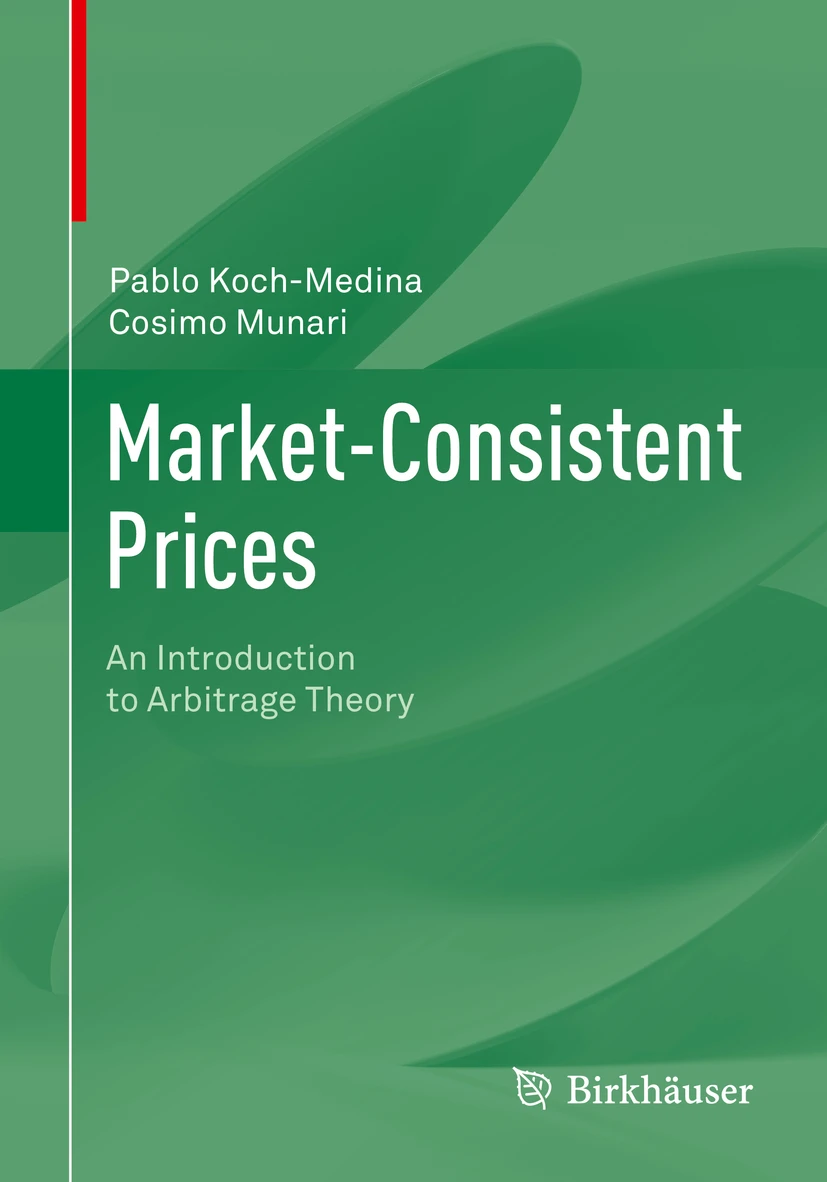
Market-Consistent Prices: An Introduction to Arbitrage Theory
Original price was: ₹7,075.00.₹5,661.00Current price is: ₹5,661.00.
Arbitrage Theory provides the foundation for the pricing of financial derivatives and has become indispensable in both financial theory and financial practice. This textbook offers a rigorous and comprehensive introduction to the mathematics of arbitrage pricing in a discrete-time, finite-state economy in which a finite number of securities are traded.
-20%
Market-Consistent Prices: An Introduction to Arbitrage Theory
Original price was: ₹7,075.00.₹5,661.00Current price is: ₹5,661.00.
Arbitrage Theory provides the foundation for the pricing of financial derivatives and has become indispensable in both financial theory and financial practice. This textbook offers a rigorous and comprehensive introduction to the mathematics of arbitrage pricing in a discrete-time, finite-state economy in which a finite number of securities are traded.
-20%
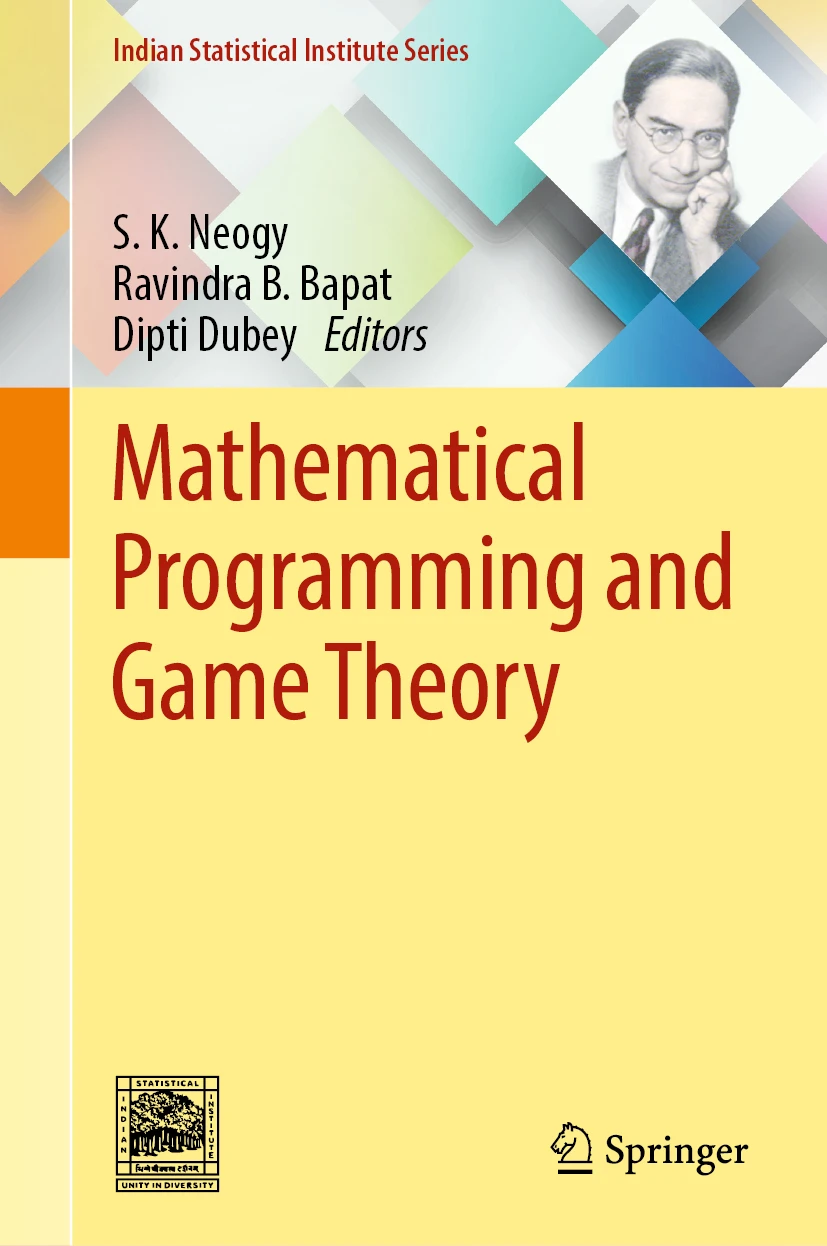
Mathematical Programming and Game Theory
Original price was: ₹10,724.00.₹8,580.00Current price is: ₹8,580.00.
This book discusses recent developments in mathematical programming and game theory, and the application of several mathematical models to problems in finance, games, economics and graph theory. All contributing authors are eminent researchers in their respective fields, from across the world. This book contains a collection of selected papers presented at the 2017 Symposium on Mathematical Programming and Game Theory at New Delhi during 9–11 January 2017. Researchers, professionals and graduate students will find the book an essential resource for current work in mathematical programming, game theory and their applications in finance, economics and graph theory. The symposium provides a forum for new developments and applications of mathematical programming and game theory as well as an excellent opportunity to disseminate the latest major achievements and to explore new directions and perspectives.
-20%
Mathematical Programming and Game Theory
Original price was: ₹10,724.00.₹8,580.00Current price is: ₹8,580.00.
This book discusses recent developments in mathematical programming and game theory, and the application of several mathematical models to problems in finance, games, economics and graph theory. All contributing authors are eminent researchers in their respective fields, from across the world. This book contains a collection of selected papers presented at the 2017 Symposium on Mathematical Programming and Game Theory at New Delhi during 9–11 January 2017. Researchers, professionals and graduate students will find the book an essential resource for current work in mathematical programming, game theory and their applications in finance, economics and graph theory. The symposium provides a forum for new developments and applications of mathematical programming and game theory as well as an excellent opportunity to disseminate the latest major achievements and to explore new directions and perspectives.
-20%

Mean Field Games
Original price was: ₹6,033.00.₹4,827.00Current price is: ₹4,827.00.
This volume provides an introduction to the theory of Mean Field Games, suggested by J.-M. Lasry and P.-L. Lions in 2006 as a mean-field model for Nash equilibria in the strategic interaction of a large number of agents.
-20%
Mean Field Games
Original price was: ₹6,033.00.₹4,827.00Current price is: ₹4,827.00.
This volume provides an introduction to the theory of Mean Field Games, suggested by J.-M. Lasry and P.-L. Lions in 2006 as a mean-field model for Nash equilibria in the strategic interaction of a large number of agents.