
-20%

The Development of the Number Field Sieve
Original price was: ₹4,260.00.₹3,409.00Current price is: ₹3,409.00.
The number field sieve is an algorithm for finding the prime factors of large integers. It depends on algebraic number theory.
The number field sieve is an algorithm for finding the prime factors of large integers. It depends on algebraic number theory.
Additional information
| Book Format | Hardcover, Softcover |
|---|
Book information
Edition
1st Edition
ISBN [Softcover]
9783540570134
Publisher
Springer
Year
1993
Pages
VIII, 140 p.
Series Title
Lecture Notes in Mathematics
Language
English
Related Products
-20%

A Course in Algebraic Error-Correcting Codes
Original price was: ₹4,990.00.₹3,993.00Current price is: ₹3,993.00.
Provides a rigorous mathematical perspective on error-correcting codes Offers a pathway from the basics to the state-of-the-art, suitable for either independent study or the classroom Corresponds to a one-semester course, where each chapter suits a two-hour lecture Includes numerous helpful exercises with selected solutions provided Includes supplementary material: sn.pub/extras
-20%
A Course in Algebraic Error-Correcting Codes
Original price was: ₹4,990.00.₹3,993.00Current price is: ₹3,993.00.
Provides a rigorous mathematical perspective on error-correcting codes Offers a pathway from the basics to the state-of-the-art, suitable for either independent study or the classroom Corresponds to a one-semester course, where each chapter suits a two-hour lecture Includes numerous helpful exercises with selected solutions provided Includes supplementary material: sn.pub/extras
-20%
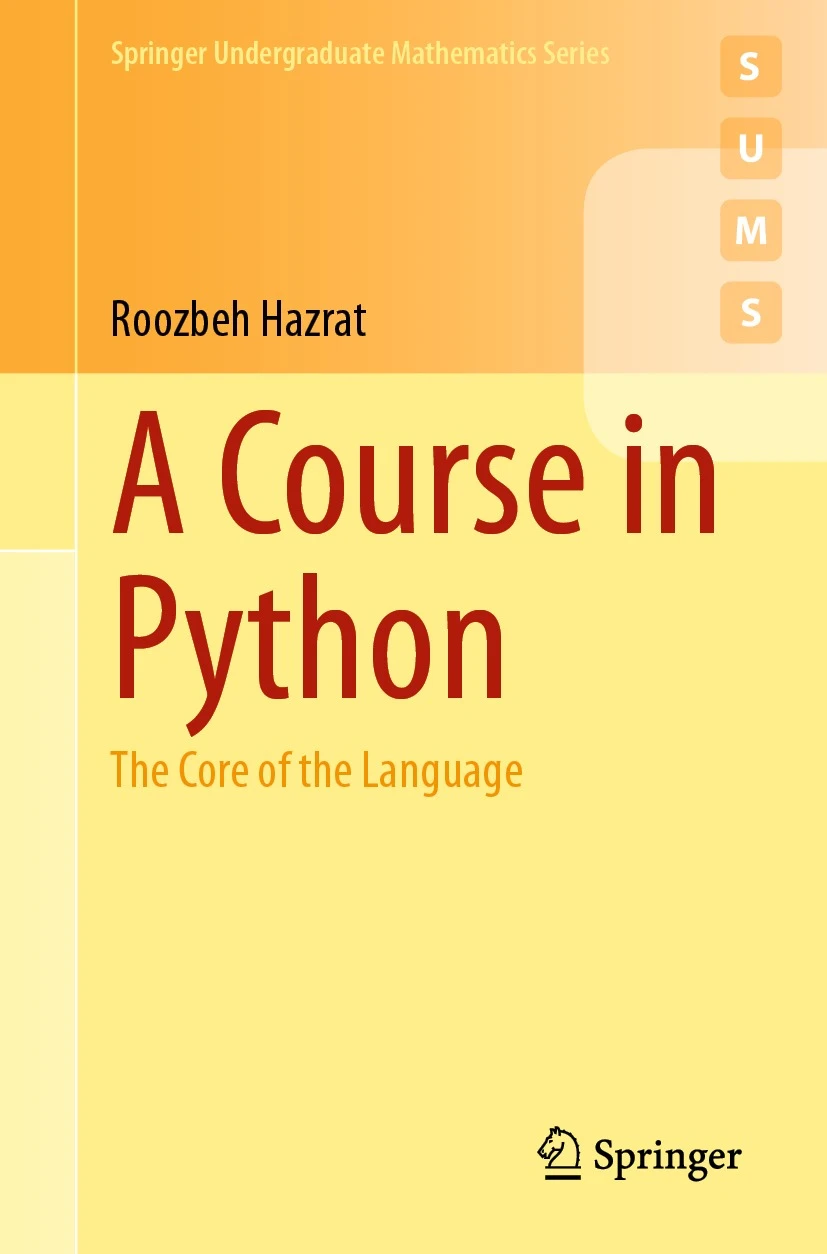
A Course in Python: The Core of the Language
Original price was: ₹5,511.00.₹4,410.00Current price is: ₹4,410.00.
A hands-on introduction to Python, ideal for a first course or self-study Provides numerous worked-out exercises showing how to write programs in Python Includes several case studies with code, as well as practice problems
-20%
A Course in Python: The Core of the Language
Original price was: ₹5,511.00.₹4,410.00Current price is: ₹4,410.00.
A hands-on introduction to Python, ideal for a first course or self-study Provides numerous worked-out exercises showing how to write programs in Python Includes several case studies with code, as well as practice problems
-20%

(In-)Stability of Differential Inclusions
Original price was: ₹6,554.00.₹5,244.00Current price is: ₹5,244.00.
Lyapunov methods have been and are still one of the main tools to analyze the stability properties of dynamical systems. In this monograph, Lyapunov results characterizing the stability and stability of the origin of differential inclusions are reviewed. To characterize instability and destabilizability, Lyapunov-like functions, called Chetaev and control Chetaev functions in the monograph, are introduced. Based on their definition and by mirroring existing results on stability, analogue results for instability are derived. Moreover, by looking at the dynamics of a differential inclusion in backward time, similarities and differences between stability of the origin in forward time and instability in backward time, and vice versa, are discussed. Similarly, the invariance of the stability and instability properties of the equilibria of differential equations with respect to scaling are summarized. As a final result, ideas combining control Lyapunov and control Chetaev functions to simultaneously guarantee stability, i.e., convergence, and instability, i.e., avoidance, are outlined. The work is addressed at researchers working in control as well as graduate students in control engineering and applied mathematics.
-20%
(In-)Stability of Differential Inclusions
Original price was: ₹6,554.00.₹5,244.00Current price is: ₹5,244.00.
Lyapunov methods have been and are still one of the main tools to analyze the stability properties of dynamical systems. In this monograph, Lyapunov results characterizing the stability and stability of the origin of differential inclusions are reviewed. To characterize instability and destabilizability, Lyapunov-like functions, called Chetaev and control Chetaev functions in the monograph, are introduced. Based on their definition and by mirroring existing results on stability, analogue results for instability are derived. Moreover, by looking at the dynamics of a differential inclusion in backward time, similarities and differences between stability of the origin in forward time and instability in backward time, and vice versa, are discussed. Similarly, the invariance of the stability and instability properties of the equilibria of differential equations with respect to scaling are summarized. As a final result, ideas combining control Lyapunov and control Chetaev functions to simultaneously guarantee stability, i.e., convergence, and instability, i.e., avoidance, are outlined. The work is addressed at researchers working in control as well as graduate students in control engineering and applied mathematics.
-20%

A Basic Guide to Uniqueness Problems for Evolutionary Differential Equations
Original price was: ₹6,033.00.₹4,827.00Current price is: ₹4,827.00.
This text develops the necessary background in probability theory underlying diverse treatments of stochastic processes and their wide-ranging applications. In this second edition, the text has been reorganized for didactic purposes, new exercises have been added and basic theory has been expanded.
-20%
A Basic Guide to Uniqueness Problems for Evolutionary Differential Equations
Original price was: ₹6,033.00.₹4,827.00Current price is: ₹4,827.00.
This text develops the necessary background in probability theory underlying diverse treatments of stochastic processes and their wide-ranging applications. In this second edition, the text has been reorganized for didactic purposes, new exercises have been added and basic theory has been expanded.
Reviews
There are no reviews yet.